Hospital Beds are specialized medical furniture designed to provide comfort, safety, and therapeutic support for patients during hospitalization, recovery, or long-term care. Unlike standard home beds, hospital beds feature adjustable height, head, and foot sections, side rails, and often wheels for mobility. They play a vital role in patient care by facilitating medical procedures, preventing bedsores, reducing fall risks, and aiding mobility-impaired individuals.
Modern hospital beds integrate advanced electronics, monitoring systems, and ergonomic designs to enhance patient outcomes and caregiver efficiency. The global market for hospital beds is driven by aging populations, rising chronic illnesses, and healthcare infrastructure growth.
A standard modern hospital bed in a clinical setting.
Another view of a contemporary acute care hospital bed.
Elegant design-focused hospital bed emphasizing patient comfort.
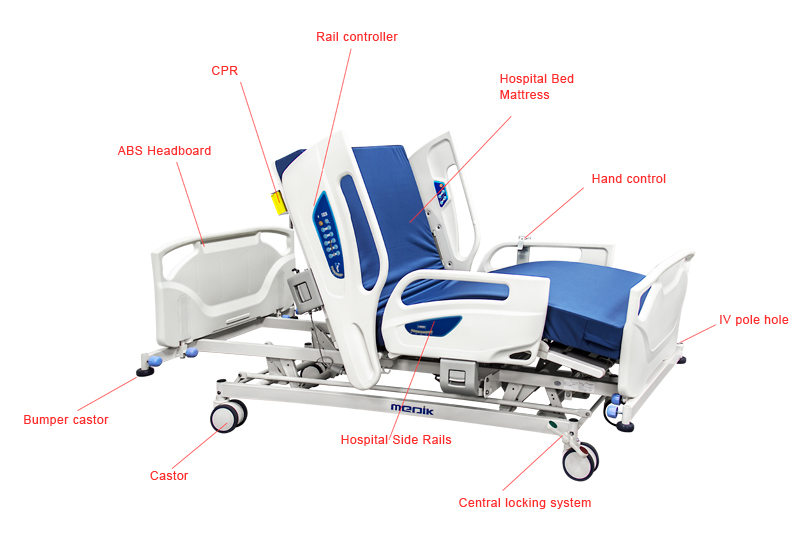
Key Features and Components
Hospital beds typically include:
- Adjustable sections: Head (Fowler position), knee, and foot elevation.
- Height adjustment: For easy entry/exit and caregiver access.
- Side rails: Prevent falls while allowing patient independence.
- Wheels and brakes: For safe transport.
- Trendelenburg/Reverse Trendelenburg: Tilting for medical needs.
- Integrated scales, bed exit alarms, and CPR release.
Labeled diagram of main hospital bed parts.
Detailed schematic highlighting safety components.
Types of Hospital Beds
Hospital Beds are classified by operation mode, patient needs, and setting.
Manual Hospital Beds
Operated via cranks at the foot end. Cost-effective for low-acuity areas or home use.
Basic manual hospital bed with crank mechanisms.
Another manual model with half rails.
Electric Hospital Beds
Powered by motors, controlled via hand pendants or touch panels. Most common in modern facilities.
Full electric adjustable hospital bed for home or hospital use.
Advanced electric model with multiple adjustments.
ICU/CCU Beds
Highly advanced with features like column lifts, X-ray translucent platforms, cardiac chair positions, and integrated vital signs monitoring.
Sophisticated ICU bed with enhanced functions.
Comparison highlighting ICU bed differences.

Bariatric Beds
Designed for obese patients, with higher weight capacities (up to 1,000+ lbs), wider frames, and reinforced construction.
Heavy-duty bariatric hospital bed.
Another robust bariatric model.
Pediatric Beds
Child-sized with colorful designs, higher rails, and safety features to prevent entrapment.
Pediatric hospital bed in use.
Low Beds
Ultra-low height (as low as 9 inches) for fall prevention in elderly or confused patients.
Low-profile fall prevention hospital bed.
Key Manufacturers
Leading companies include Hill-Rom (Baxter), Stryker, Invacare, Arjo, Linet, and Paramount Bed. They focus on innovation in smart beds with IoT connectivity for pressure ulcer prevention and remote monitoring.
Benefits and Safety Considerations
Hospital beds improve patient comfort, reduce pressure injuries through alternating mattresses, and enhance caregiver ergonomics by minimizing lifting strains. Safety standards (e.g., IEC 60601-2-52) address entrapment zones, rail strength, and electrical safety.
Challenges include infection control (requiring easy-clean surfaces) and maintenance of complex electronics.
Future Trends
Smart beds with AI for early warning of deterioration, integrated telehealth, and sustainable materials are emerging. Home hospital beds are growing with aging-in-place trends.
Conclusion
Hospital beds are far more than simple furniture—they are critical therapeutic tools that directly impact patient recovery, safety, and healthcare efficiency. Advances in design and technology continue to make them more patient-centered, supporting better outcomes in diverse care settings.
More articles by ZMR Researche:
https://www.zionmarketresearch.com/de/report/vietnam-elevators-and-escalators-market
https://www.zionmarketresearch.com/de/report/organic-binders-market
https://www.zionmarketresearch.com/de/report/pour-point-depressants-market
https://www.zionmarketresearch.com/de/report/automated-sample-digestion-systems-market
https://www.zionmarketresearch.com/de/report/maltodextrin-market