Confinement Centers: Revolutionizing Postpartum Care in Asia and Beyond in 2025

Introduction
Confinement centers, also known as postpartum care centers or postnatal retreats, are specialized facilities dedicated to supporting new mothers and their newborns during the critical postpartum period. Rooted in ancient traditions like the Chinese “zuo yue zi” (sitting the month), these centers provide a structured environment for recovery, blending cultural practices with modern medical and wellness services. Typically involving a stay of 28-40 days (or longer), mothers receive expert care focused on physical healing, nutrition, emotional support, and newborn bonding, while 24/7 staff handle infant care.
As of December 2025, the global confinement center market is experiencing rapid growth, valued at approximately USD 7-9 billion in 2024-2025, with projections reaching USD 12-29 billion by 2030-2033 at CAGRs of 15-20%. This boom is driven by rising birth rates in Asia, dual-income families lacking extended support, increasing awareness of postpartum health, and the luxury wellness trend. Predominantly in Asia (China, Malaysia, Singapore, Taiwan, South Korea), the model is expanding to the West as “postnatal retreats.” This article explores the history, services, benefits, market dynamics, leading providers, challenges, and future of confinement centers.
Historical and Cultural Roots
The practice of postpartum confinement dates back over 2,000 years in Chinese culture, emphasizing rest, warmth, and specific diets to restore balance and prevent future ailments. Similar traditions exist in Korea (sanhujori), Latin America (la cuarentena), and other regions. Traditionally done at home with family or a “confinement nanny,” the rise of nuclear families and urbanization led to professional centers emerging in the 1990s-2000s, first in Taiwan and South Korea, then spreading to China and Southeast Asia.
In modern confinement centers, traditions like avoiding cold foods/drinks and focusing on “warming” ingredients are integrated with evidence-based care, such as lactation support and mental health resources.
Services Offered in Confinement Centers
Confinement centers provide comprehensive, all-in-one care:
- Accommodation: Private suites with hotel-like amenities (king beds, en-suites, blackout curtains).
- Nutrition: Customized meals (5-6 daily) based on TCM principles—ginger, sesame, pork vinegars for recovery and milk production.
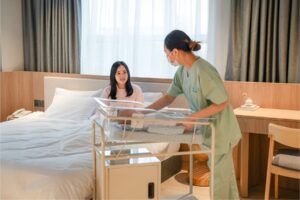
- Newborn Care: 24/7 nursery with trained nurses for feeding, diapering, and monitoring; real-time video access for mothers.
- Maternal Recovery: Postnatal massages, belly binding, wound care (C-section/episiotomy).
- Wellness & Education: Lactation consulting, yoga, parenting classes, mental health support.
- Additional Perks: Spa treatments, aesthetic services, family stay options.
Stays range from basic (hospital-attached) to luxury (hotel-style villas).
Benefits of Confinement Centers
- Physical Recovery: Structured rest reduces postpartum complications; specialized diets boost healing and lactation.
- Emotional Support: Lowers PPD risk through professional care and community.
- Newborn Health: Expert monitoring ensures optimal start.
- Convenience: Ideal for working parents; allows bonding without household chores.
- Cultural Preservation: Honors traditions while incorporating modern science.
Studies show mothers using centers report higher satisfaction and faster recovery.
Market Size and Growth Trends
The market is Asia-dominated, with China leading due to high birth rates and urbanization.
| Year | Market Size (USD Billion) | CAGR (%) | Key Regions |
|---|---|---|---|
| 2024 | 5.27-7.81 | – | Asia-Pacific (80%+) |
| 2025 | 7.5-9.04 | 15-20 | China, Malaysia, Singapore |
| 2030 | 12.3-18.84 | 15-20 | Expansion to West (US retreats) |
| 2033 | 16.94-29.26 | 15.8 | Luxury segment growth |
Drivers: Dual-income households, delayed parenthood, wellness trends. Emerging Western models (e.g., Boram, Ahma & Co) adapt for non-Asian audiences.
Leading Confinement Centers and Providers
Asia features luxury options:
- Malaysia: Joie, Nejlika, PEM, Kimporo (high-end TCM focus).
- Singapore: Singjoy (Shangri-La), Newlife, Kai Suites.
- China/Taiwan: Saint Bella, Esther Postpartum Care.
- Johor (Popular for Singaporeans): Cozzi, Ladies Paradise (cheaper cross-border).
Western retreats: The Village (US West Coast), Fourth Trimester (Chicago), Boram (NYC)—shorter stays, insurance-friendly.
Costs: SGD 20,000-100,000+ in Singapore; cheaper in Malaysia (RM 10,000-50,000).
Challenges and Criticisms
- High Costs: Limits access to affluent families.
- Cultural Rigidity: Strict rules may not suit all.
- Quality Variation: Unregulated in some areas.
- Western Skepticism: Evidence mixed on traditional practices.
- PPD Risks: Isolation if not community-focused.
Future Trends
By 2030: Hybrid models (home + center), tech integration (apps for monitoring), sustainability (eco-friendly meals), global expansion. Rising focus on mental health and inclusivity for diverse families.
Conclusion
Confinement centers represent a fusion of ancient wisdom and modern luxury, offering invaluable support during one of life’s most transformative periods. In 2025, with a booming market and evolving services, they empower mothers to recover fully and embrace parenthood confidently. Whether rooted in cultural tradition or seeking structured postpartum care, these centers highlight the growing recognition that new mothers deserve dedicated healing time. For expectant parents, researching accredited options ensures the best fit for a nurturing start to family life.
More articles by InnovateIQ Researche:
https://www.zionmarketresearch.com/de/report/5g-mmwave-market
https://www.zionmarketresearch.com/de/report/communications-service-providers-csp-market
https://www.zionmarketresearch.com/de/report/animal-radio-collar-market
https://www.zionmarketresearch.com/de/report/non-insulin-therapies-for-diabetes-market
https://www.zionmarketresearch.com/de/report/chambered-doctor-blade-systems-market